


By Maja Kaurin
In early 2023, I had the opportunity to visit the Josef Albers Museum Quadrat in Bottrop, Germany, and take part in a 2-day workshop with a special focus on the pedagogy of Josef Albers. A tour of the temporary exhibition Josef Albers: Huldigung an das Quadrat (Homage to the square) was part of the workshop.
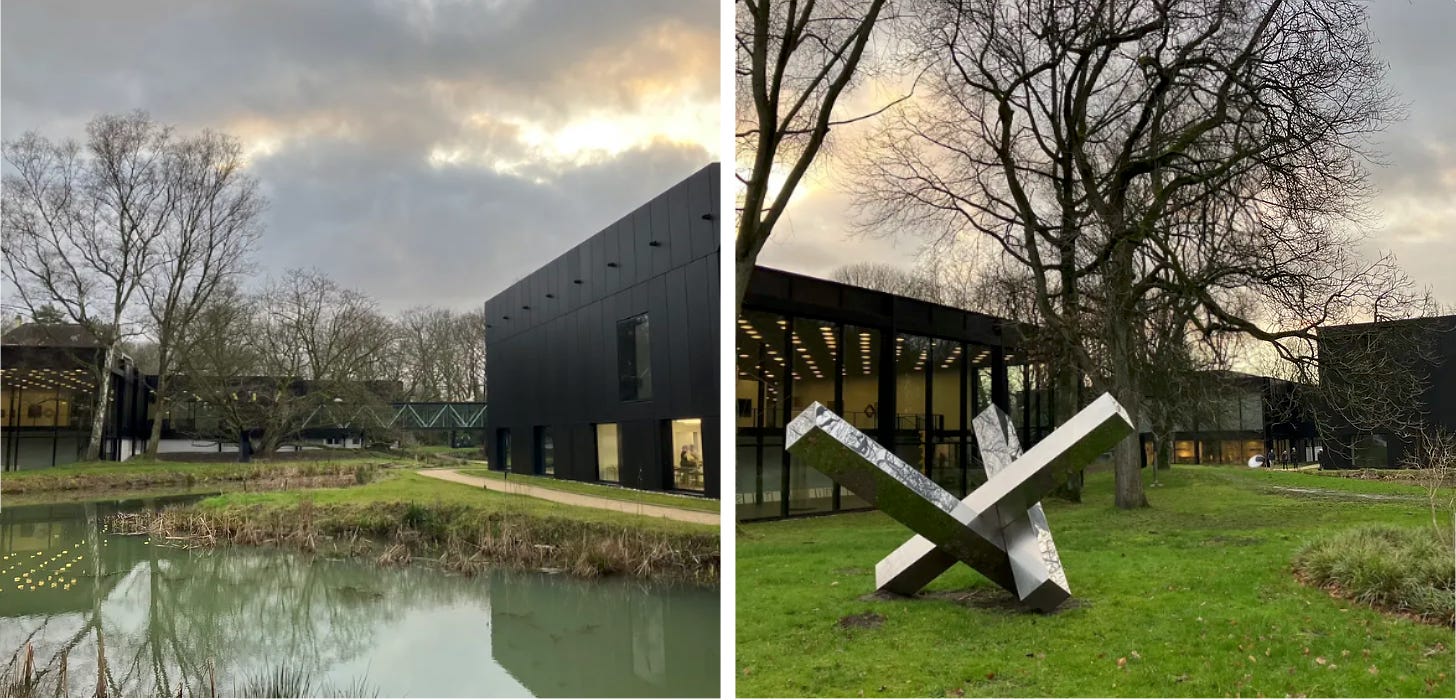
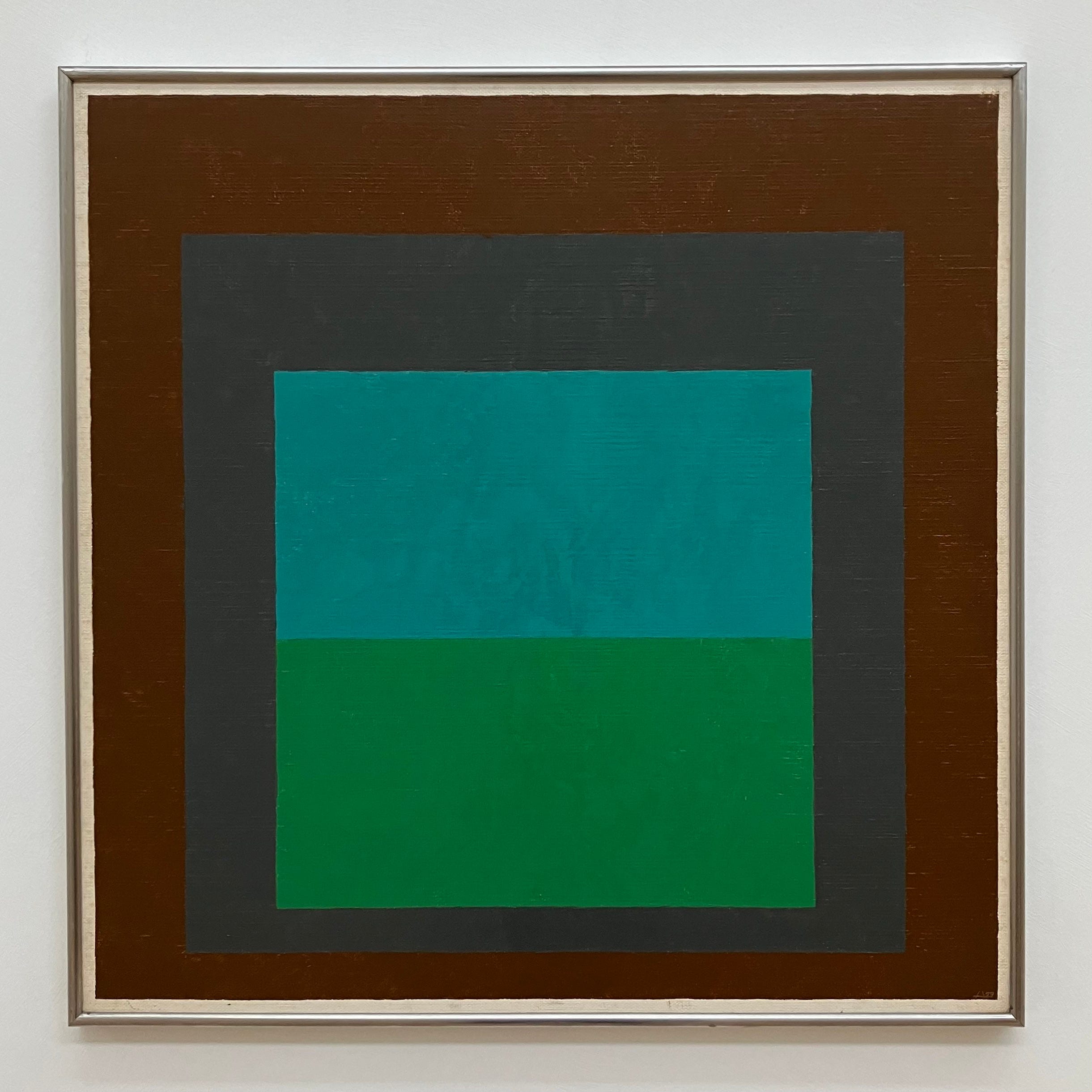
While exploring the rooms of a beautiful, soft-lit museum building, catching glimpses of the sleepy Stadtgarten Park through the large windows, I slowly passed through the white rooms full of Albers’s paintings. There was only an hour of time, and, of course, it was not enough to take it all in. I stood in front of the paintings, admiring the depth of colour on some and the lightness and low opacity on others, the interaction of a specific colour of a square within a colour of another square, creating a sort of halo effect, bringing another colour to life that is not there, and yet we see it.
So many combinations, so many possibilities. It is no wonder that Albers created more than two thousand works within his Homage to the square series and often expressed that a million years would not be enough to explore all the possible combinations and discover all that is to learn about colour. I couldn’t agree more.
His Homage to the Square oeuvre could easily be called Homage to Colour since it doesn’t have as much to do with the square as it has all to do with colour. Colour is present fully with its raw materiality that transcends boundaries, never to be confined between the lines, but instead existing in a constant, often mysterious interplay with its neighbour, thus creating new fields and spaces of colour, sometimes pulling you in, sometimes keeping you out, even letting light emerge from the canvas.
There is something deeply meditative and poetic in the squares of Josef Albers and it is that fragile state of being in which colour dwells, a sort of transcendence, that attracts me in his work and pushes me to explore, to look, to understand.
Josef Albers likened the behaviour of colours to the dynamics of human behaviour. We behave differently in a group than when we are alone, when among friends and family or among strangers. It is that dynamics in the interaction of colour that provides so many possibilities for shaping space with colour.
“When you really understand that each colour is changed by a changed environment, you eventually find that you have learned about life as well as about colour.”
-Josef Albers (from Josef Albers: The American Years, Washington 1965, p. 28).
I believe the exploration of colour is a life-time quest and it would take several lifetimes to grasp it all, to experiment, explore and create all that can be done.
This weekend I will be returning to the Josef Albers Museum Quadrat in Bottrop for the workshop Interaction of Colour in Space (June 27-28, 2026).
The idea of this workshop was born during that first visit to the Museum in 2023. It has been in preparation for more than 2 years, and it is a true team effort, spanning continents. Organised by two colour associations (of Belgium and of Germany), with the support of the Josef and Anni Albers Foundation from the US and the Josef Albers Museum Quadrat in Germany, with the lecturers from Spain, Switzerland, and Germany, it is truly international. Colour unites.
It has been a pleasure to organise this workshop, and I am looking forward to making new connections, new insights and new colourful memories this weekend.
The workshop registration has closed, but if anyone would still like to jump in and join at the last minute, send us a message; we still have one place left. And there is air-con at the museum :)
Read the full Essay here: Colours of Memory - Josef Albers, Paul Cézanne and memories of home.
- Maja Kaurin is Croatian-Hungarian architect, environmental colour designer and educator. She serves as a vice-president of Interdisciplinary Colour Association Belgium (ICA-Belgium). She writes The Colour Spotter Chronicles and sometimes calls herself a walking artist.
This essay is part of a Collection of Essays dedicated to Josef Albers, where the organisers of the workshop Interaction of Colour in Space share their thoughts about Josef Albers and his impact on their work.
For more information about the upcoming workshop, see:
