

Colour News May 2026 - No. 2
Colour related news and events

Welcome to the second May edition of ICA-Belgium Colour News, bringing you colour related news from Belgium and around the world.
Our Open Call for Albers Accessibility Awards with focus on early-career practitioners is here! We invite you to read another article from the Collection of Essays dedicated to Josef Albers, this time by our own Inez Michiels. Check the international symposia dedicated to colour and an exhibition that caught our attention.
Warm greetings from Belgium,
-your ICA-Belgium team
Open Call for Early-Career Professionals
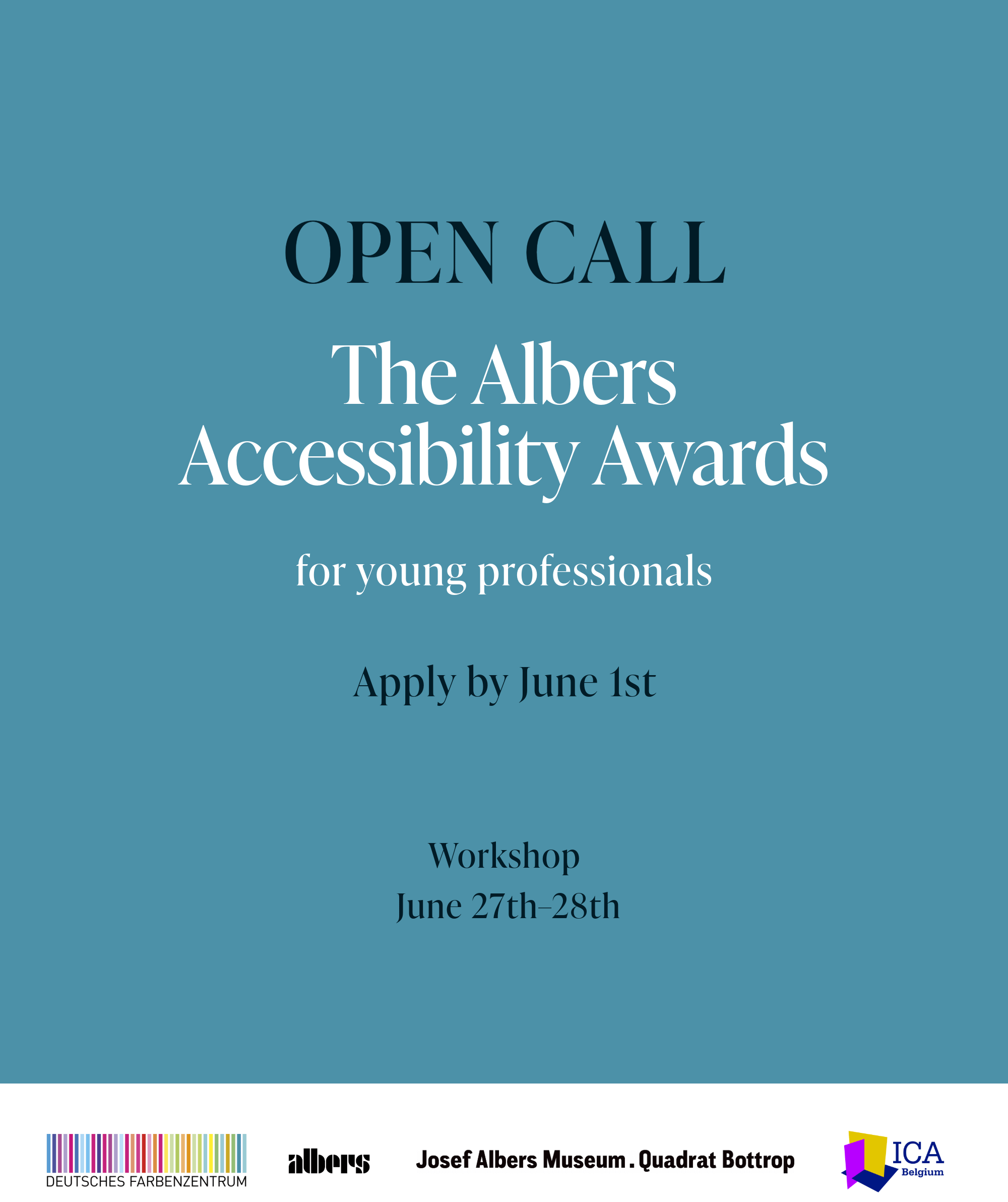
ICA-Belgium and the Deutsches Farbenzentrum (German Colour Association), with the generous support of the Anni and Josef Albers Foundation, are pleased to open a second call for the Albers Accessibility Awards - this time dedicated to young and early-career professionals in architecture, design, and art.
Two subsidised places are available for our upcoming two-day intensive workshop Interaction of Colour in Space, taking place at the Josef Albers Museum Quadrat in Bottrop, Germany, on June 27–28, 2026.
The Awards
Thanks to the Albers Accessibility Fund, successful applicants will pay a reduced fee of just €40 (standard fee: €350).
*Please note that travel and accommodation are not covered by the award.
Who can apply
Practitioners in architecture, design, or art who completed their degree no more than five years ago (graduating year 2020 or later).
How to apply
Submit the following to ica@ica-belgium.org with the subject line: Albers Accessibility Award – Young Professional – [Your Full Name]
A short essay (max. 250 words): Describe a question about colour in space that is currently relevant to your professional practice, and explain how participating in this workshop would help you explore or advance it.
A link to your professional profile (LinkedIn, portfolio website, or institutional page).
Application Deadline: 1 June 2026 (end of day, CET)
Notification of Results: Successful applicants will be notified by email no later than 8 June 2026.
Collection of Essays on Albers
This essay is part of a Collection of Essays dedicated to Josef Albers, where the organisers of the workshop Interaction of Colour in Space share their thoughts about Josef Albers and his impact on their work.
Hommage to Josef Albers
By Inez Michiels
Interaction of Color by Josef Albers was a relatively late discovery for me. My artistic education was shaped primarily by The Art of Color by Johannes Itten. In this work, Itten combines theoretical reflections with visual demonstrations that explore colour interaction through his theory of the Seven Colour Contrasts. Yet the approaches of these two artists and colour theorists differ in important ways. Itten’s colour theory is a structured system explaining how colours are organized, how they contrast and harmonize, and how they can produce expressive and psychological effects in art. His ideas reflect the early twentieth-century belief that visual language could reveal deeper psychological or universal truths.
Neither Itten nor Albers sought to express personal emotion in the gestural sense associated with the artists of Abstract Expressionism. Their emphasis, however, differs. Itten combined perceptual study with expressive interpretation, whereas Albers concentrated almost entirely on perception itself. He was fascinated by the relativity and instability of colour, arguing that colour is fundamentally deceptive: it is almost never perceived as it physically is, but always in relation to its surroundings. In this sense, Albers’ work can be interpreted as a critique of Bauhaus colour theories associated with Itten and Wassily Kandinsky. Rather than proposing universal symbolic meanings, Albers emphasized experimental observation. For him, meaning emerges solely from context, from perceptual relationships.

While Albers successfully dismantled what he saw as the rigid or mystical aspects of earlier colour systems, his focus on contextual relativity may obscure another dimension of colour perception. Contemporary neuroscience suggests that human perception is not entirely neutral. Evolutionary biology appears to have shaped certain physical and emotional responses to particular wavelengths. From this perspective, some of Itten’s ideas, often dismissed as dogmatic or mystical, may instead reflect intuitive observations of underlying biological tendencies. A more complete understanding of colour may therefore lie in bridging these perspectives: acknowledging Albers’ insight that context profoundly alters perception, while also recognizing that biology provides a foundational emotional framework. Otherwise, the postmodern rejection of universals risks discarding genuine biological patterns along with outdated theoretical assumptions.
Albers’ major contribution lies above all in his pedagogy. He repeatedly emphasized that colour cannot truly be understood through description alone; it must be tested through observation and experiment. In this sense, his teaching remains remarkably relevant today.
The workshop Interaction of Colour in Space, organized by ICA Belgium and the Deutsches Farbenzentrum and inspired by Interaction of Color, offers an opportunity to revisit these questions through practice. By working with colour in spatial and perceptual exercises, participants can experience firsthand the shifting relationships that fascinated Albers, while also considering how recent insights from neuroscience and biological psychology suggest that our perception of colour is shaped not only by context but also by deeper physiological and evolutionary responses.
-Inez Michiels read Colour and Semantic Design at ENSAV La Cambre in Brussels and has been an internationally visiting professor at universities and colleges, including MICA (Baltimore), LASALLE (Signapore), and the University of Antwerp. Her research on nonverbal communication has guided design agencies and companies. She is the author of Symbol Constructions and The Design Semantics Knowledge Graph. She is also co-founder and serves as the secretary general of the Interdisciplinary Colour Association Belgium (ICA-Belgium).

Members’ News
Felix A. D’Haeseleer
Workshop Color: words, relations, boundaries, interactions
24 October 2026 (1st meeting) and 21 November 2026 (2nd meeting), Brussels
Limited to 6 participants to ensure personalized instruction.

This specialized, two-part seminar offers a methodical dive into color theory, sharpening the “eye” through practical application and collective analysis.
The seminar explores color not as an isolated element, but as a relationship. Key topics include:
Comparative Analysis: Distinguishing and describing color characteristics.
Boundary Dynamics: Modulating the appearance of boundaries through coherent color relationships to organize space.
Interactions: Predicting and managing the effects between contiguous colors.
This intensive program consists of two inseparable 7-hour sessions spaced 30 days apart.
Inquiries & Registration: For more information see Le Séminaire de Couleur or contact Felix D’Haeseleer directly at Felix.A.DHaseleer@gmail.com.
Colour Circle Book Club

1st meeting 31 May 2026 at 14:00 CEST, online
At ICA-Belgium we believe that colour becomes richer when we explore it collectively. The Colour Circle - ICA-Belgium’s Colour Book Club - is a space where you can discover inspiring books on colour, exchange insights, and reflect on how colour shapes our work, our thinking, and our daily lives.
The Colour Circle Book Club is open to ICA-Belgium members and paid subscribers (monthly or yearly). The first meeting will take place online.
Find more information about the Colour Circle Book Club here.

Enjoy 20% OFF all Print + eBooks at Routledge, across all markets, along with Free Standard Shipping. Offer valid until 31st May 2026 (23:59 EST).
*Transparency Disclosure: ICA-Belgium is an affiliate of Routledge. We may earn a small commission from qualifying purchases made through these links, at no cost to you, which helps support our mission.
Colour Exhibitions on our radar
Into the Blue
Brighton Museum & Art Gallery, UK, until 20 September 2026

Dive into the deep blue sea and sky. When we look up on a cloudless day we see bright blue sky, and at night the firmament is inky blue. We are surrounded by blue. For this new display, curator and colour historian Dr Alexandra Loske has chosen blue drawings, prints and paintings from Brighton & Hove Museums’ collections. Each one tells a different blue story.
More information: https://brightonmuseums.org.uk/event/into-the-blue/

Symposium Color Impact 2026: Defining Color
June 24, 2026 12:00pm - 5:00pm EDT, online
By the Inter-Society Color Council
Featuring presenters from a range of fields and practices, speaking on how they define color in their daily workflow. Q&A to follow each session. We will wrap up the day with Colorful Connections, an opportunity to network with ISCC members and Symposium attendees.
More information and registration: https://iscc.org/Color-Impact

AlC2026 Midterm Meeting
September 3-5, 2026, Florence, Italy
Limited to 150 participants
The AIC 2026 Midterm Meeting is dedicated to the theme of Color and Cultural Heritage.
The official opening ceremony will take place in the magnificent Salone dei cinquecento at Palazzo Vecchio, one of Florence’s most iconic and historic venues.
This meeting offers a unique opportunity for researchers, professionals, and enthusiasts to engage in deep discussions on the latest advancements in colour science, digital imaging, lighting, and cultural heritage preservation.
The event will feature general sessions alongside three special sessions, each addressing key areas of research:
Color Photography and Film – Chairs: Alice Plutino & Barbara Cattaneo
Shedding a new Light on Cultural Heritage – Chairs: Andrea Siniscalco & Laura Bellia
The Colors of Historical Cities – Chairs: Maurizio De Vita
More information and registration: https://www.aic2026.org
ICA-Belgium is a community of colour lovers that share a common interest in colour, spanning the fields of art, design, architecture, science, industry, education, linguistics, philosophy, history…
Join us and get to know other colour professionals and enthusiasts from all around the world (yes, we have international membership!), share about your work, develop opportunities for collaboration, build connections and contribute to a dynamic colour platform.
As a nonprofit organisation, run entirely by volunteers and on a very limited budget, we are counting on you to help us continue offering free online Colour Talks, colour related information and accessible colour related events and education. Consider to either become an ICA-Belgium member, or a paid newsletter subscriber. You can also buy ICA a coffee.